
From Idea to Impact: The Missing Link in Climate Technology (Towards COP31)
Dr E. Serdar GÖKPINAR – Director of Innovative Technology Programmes, Technology Development Foundation of Türkiye (TTGV)
“In a world of deepening crises and accelerating technological transformation, how will we build the future?” I believe we need to begin with this fundamental question.
Throughout history, periods of change in economic systems, institutions and balances of power have brought not only crises but also new opportunities and avenues for development. Today, we are living through another such transformation. Advances in digitalisation, artificial intelligence, biotechnology and energy systems are reshaping how we produce, make decisions and create value, while interconnected challenges such as the climate crisis and geopolitical tensions are deepening.
Finding a way out of this turbulence—where crises are intensifying even as our capacity for innovation expands rapidly—depends on humanity mobilising three fundamental strengths: the ability to learn and adapt, to build institutions and to innovate. Scientific research, R&D and technological innovation strengthen all three, enhancing humanity’s ability to solve problems and opening up new possibilities for shaping the future.
Why is TTGV at COP?
At the Technology Development Foundation of Türkiye (TTGV), we are preparing for COP31, to be held in Antalya on 9–20 November, guided by the understanding that the climate transition is, at its core, a technological transformation. As humanity’s production and consumption systems are reshaped, we aim to play an active role in this transformation, drawing on our 35 years of experience and our pioneering approach to technological innovation. This time, with Türkiye as host, we aim to give greater prominence on the international agenda to the perspectives and approaches we presented at COP28 in Dubai and COP29 in Baku.
Founded in 1991 to strengthen private-sector competitiveness through technology, TTGV pursues its vision of a Türkiye that develops technology (#teknolojiuretenturkiye), drawing on its public–private partnership structure and its culture of sharing knowledge and experience. Our approach is to break new ground rather than duplicate existing efforts. Through the flexible programme models developed on this basis, we identify priority technologies, take on risk, bring first-of-a-kind projects to life, and share the resulting knowledge and experience with the wider ecosystem.
Transforming the techno-economic system
All human activity entails carbon emissions and environmental impacts. The direction of travel is clear: minimise the use of energy, water, natural resources and land; minimise greenhouse gas emissions; maximise efficiency; minimise waste generation and wasteful consumption; and maximise circularity. This means transforming almost the entire techno-economic system.
Individual efforts matter, but a systemic problem can only be addressed through systemic solutions delivered by collective action. Each region, country and sector will need different solutions, and every available option will be used to a greater or lesser extent. Unfortunately, there are no quick or easy fixes, because this transformation is ultimately about rebuilding human systems. It is a complex undertaking that demands advanced expertise, patience and substantial financial resources. Those who harness innovation as a driving force for sustainability will be the ones able to carry this transformation through successfully.
Not all climate technologies are ready yet
In the climate technology literature, solutions are assessed in terms of three objectives. Mitigation aims to reduce greenhouse gas emissions or remove greenhouse gases from the atmosphere; adaptation seeks to make systems resilient to the unavoidable impacts of climate change. Residual risk management involves monitoring and managing risks that mitigation and adaptation cannot fully prevent.
Yet in none of these three areas is the full range of technological solutions ready. R&D is still under way on many fronts. Some “green” solutions that have completed the R&D phase remain more expensive than their “dirty” alternatives, while others struggle to scale up rapidly. Depending on the context, different solutions may also serve as alternatives to one another. Moreover, systematic frameworks and markets for comparing and evaluating these solutions have yet to emerge.
On the road to COP31
Despite the criticism, COPs remain the only climate platform capable of bringing almost every country to the same table. The Paris Agreement, the Loss and Damage Fund and the call to transition away from fossil fuels all emerged from this process. According to the United Nations Environment Programme, projected end-of-century warming, estimated at 3–3.5 °C before Paris, now stands at 2.8 °C under current policies, falling to 2.3–2.5 °C if pledges are fully implemented.
However, much of this progress remains at the level of pledges. Consensus-based decision-making pulls commitments towards the lowest common denominator, while the gap between announced targets and implementation on the ground is measured anew each year. The sums pledged are also modest. For example, the approximately $700 million pledged when the Loss and Damage Fund was established was described as “a drop in the ocean” compared with the scale of the need. Making pledges is not the same as solving the problem.
Türkiye’s description of COP31 as an “Implementation COP” reflects a determination to turn climate goals into tangible solutions. The Action Agenda developed by the COP Presidency to this end spans ten themes, from clean energy and green industrialisation to resilient cities and food security. Finance, technology and capacity-building stand out as shared enablers across all these areas.
Real transformation requires more than access to technology: it also depends on developing it, adapting it to local needs and deploying it widely. Technology partnerships must therefore go beyond the transfer of off-the-shelf solutions and be built around joint R&D, production and institutional capacity-building.
One of Türkiye’s greatest contributions to the world during its presidency year could be to make implementation measurable and take concrete steps to improve developing countries’ access to the technologies needed for the transition.
A key question, then, is this: How will technological capabilities be built?
What is really missing: a bridge
Technology alone is not a solution. It delivers impact when it works in conjunction with other types of solutions: production practices; physical and natural infrastructure; knowledge and human capital; business models and organisational arrangements; finance and risk-sharing; and policy and governance.
This is the basis of our central argument: the main bottleneck in climate action is not so much whether a technology exists as the absence of a mechanism to take it from idea to implementation, from the laboratory to real-world benefit. In many developed and developing countries, good technological options are already available in certain areas. What is missing is the bridge that will bring these technologies to maturity, test them and turn them into projects that are both bankable and feasible to implement.
Building this bridge requires a substantial technological innovation effort that goes beyond R&D: preparing the market, building knowledge and skills across the ecosystem, testing technologies to establish their techno-economic parameters, and developing the capabilities of technology stakeholders and the prospective value chain. TTGV’s 35 years of experience are centred on precisely this task: building the bridge.
COP31’s central challenge: implementation
At COP31, we will put forward TTGV’s arguments through numerous panel discussions in the Blue and Green Zones, under two main themes.
First, the Climate Implementation Bridge. Co-designed with Brazil’s Center for Strategic Studies and Management (CGEE), this session will take place both at the Türkiye Pavilion and as part of the UNFCCC’s official side-event programme. Its title also exactly matches the “Climate Implementation Bridge (BRIDGE)” theme in the COP31 Presidency’s Action Agenda. Through demand-driven mechanisms and concrete demonstration projects, we will show how two developing countries—Türkiye and Brazil—are taking climate technology from commitment to implementation. The session brings together Türkiye’s experience and the Belém Technology Implementation Programme adopted at COP30.
Second, Green Industrialisation. Together with the Ankara Chamber of Industry, the Presidency of Strategy and Budget of the Republic of Türkiye, and Azerbaijan, we will explore industry’s green and digital transformation—the twin transition. The question is how industrial clusters and economic zones can become decarbonisation hubs that turn climate goals into investment. We will also continue to present our arguments in other sessions on technology and technological innovation.
Two different themes, one common thread: moving climate goals from words to action, and technology from promise to practice.
This is precisely why Türkiye’s description of COP31 as an “Implementation COP” matters. As the Presidency’s letter to the Parties notes, the central challenge is now shifting from setting targets to delivering on them. COPs are often remembered as forums where pledges, targets and negotiations dominate the conversation. Yet the real question is how those targets will be achieved. At TTGV, we are bringing this question to COP31, and we aim to answer it through projects already under way and concrete examples on the ground.
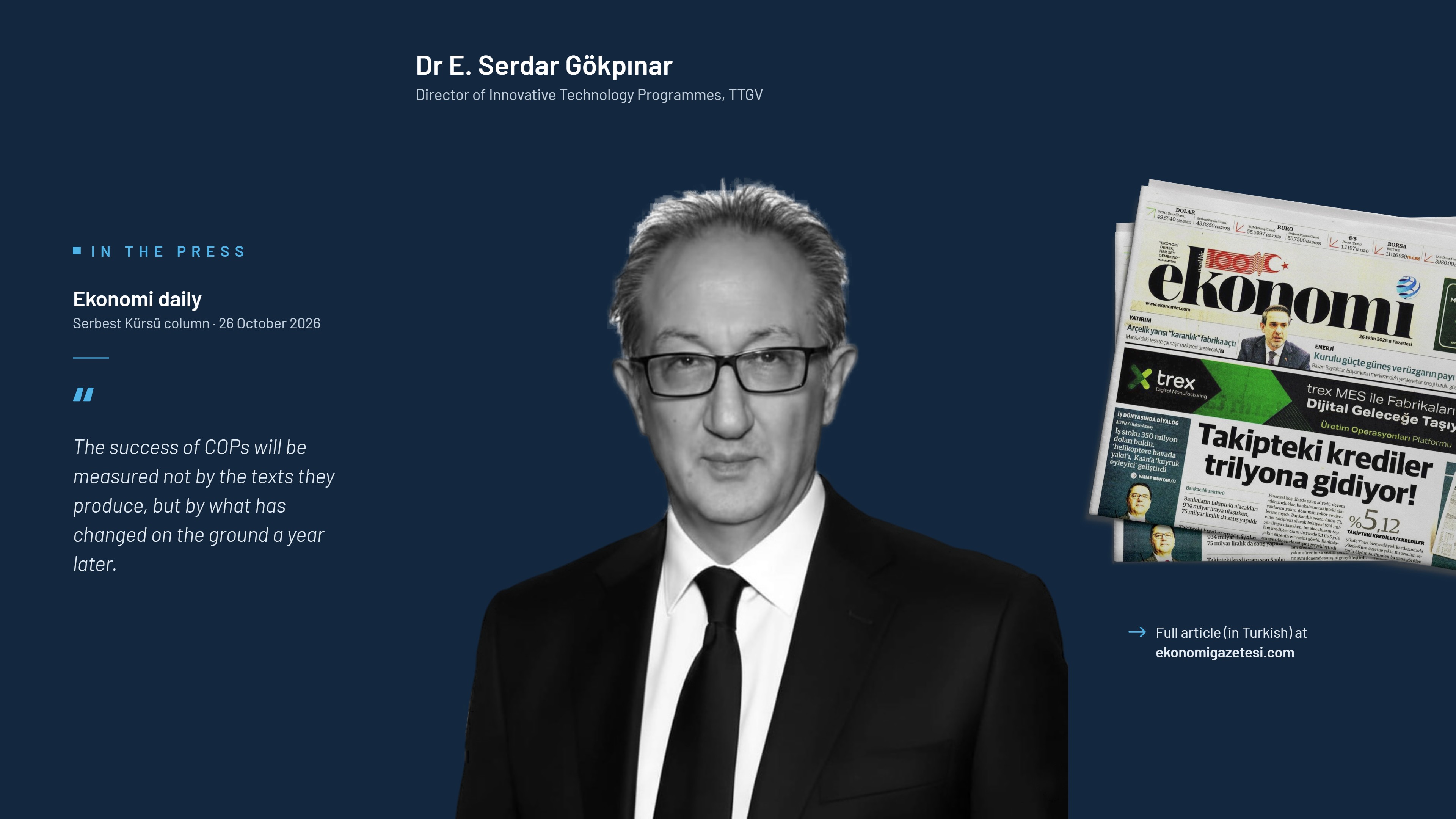
For it is not the brightest ideas that will win the fight against climate change, but the mechanisms that put those ideas into practice. Let us not forget: the success of COPs will be measured not by the texts they produce, but by what has changed on the ground a year later.

