
Pioneer Project
Program
We aim to build capacity in our country within TTGV's focus areas, and to contribute to sectoral growth as well
as the creation of production and supply chains by paving the way for emerging technologies.

Developing the Demand Side
To create application examples and catalyze the sector by conducting initial demonstrations of pioneer technologies.
Strengthening the Supply Side
To support the market alignment of early-stage technologies and ensure their preparation for commercialization.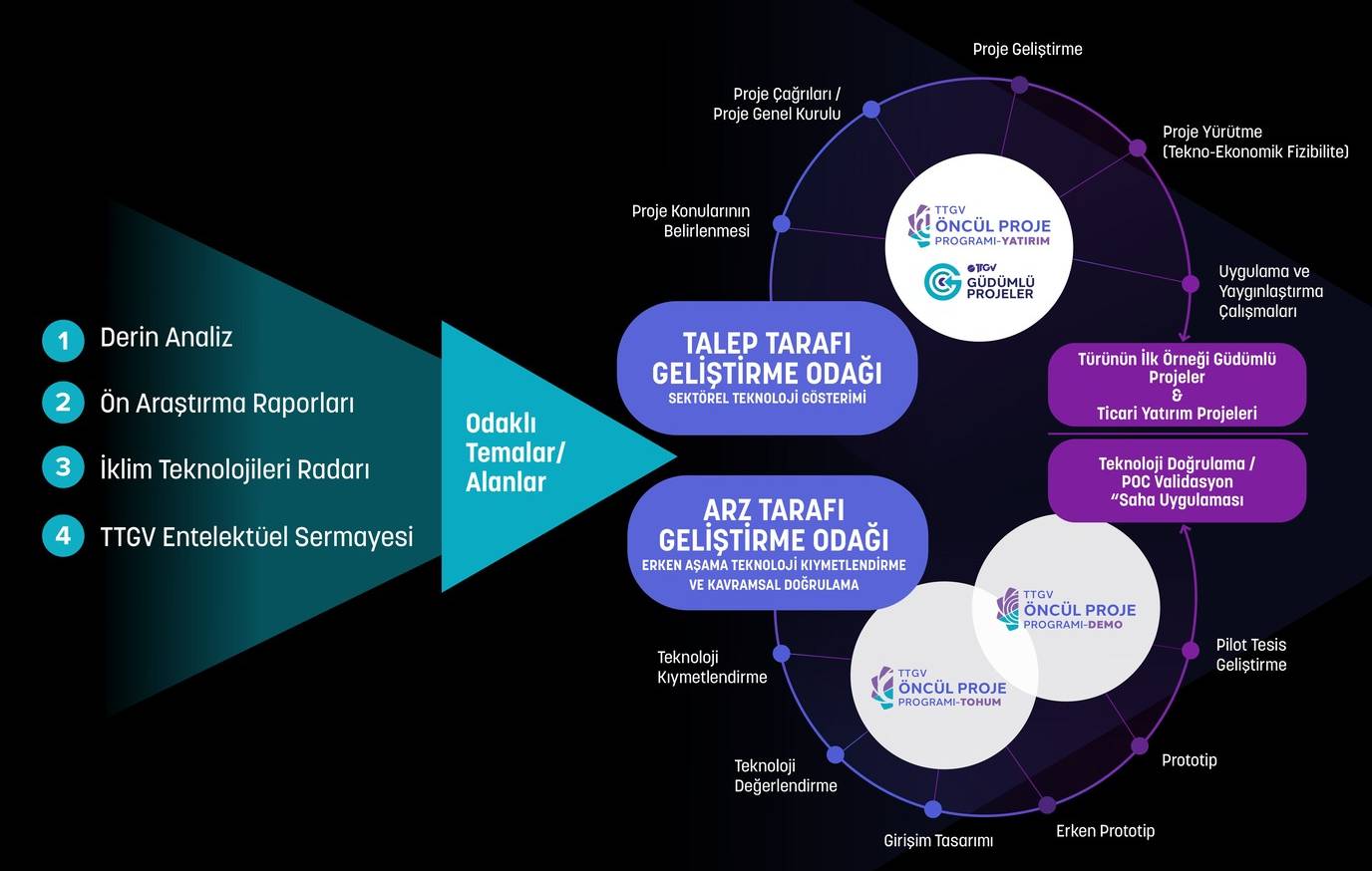

Pioneer Project Investment Program
Demand-Side Development
This is a Pioneer Project Program that aims to research emerging technology solutions that will serve as examples for the pioneer climate technology applications determined by TTGV in our country through in-depth analytical studies; to implement its findings through technology demonstration projects; and to accelerate the technology adoption process of our national industry by disseminating the industrial knowledge generated.

Guided Project (GÜP) Program
Demand-Side Development
The transition process of climate technologies from laboratory environments to real-world applications is recognized as the most critical threshold of innovation due to high technical and economic uncertainties. To bridge this "Valley of Death," we at TTGV focus on pre-commercialization technology demonstrations through our Guided Project (GÜP) Program.
GÜP is not merely a support program; it is a catalytic model in which TTGV defines the demand, assumes the first risk, and actively steers the process in alignment with its strategic priorities. By validating innovative solutions that will enhance the competitiveness of our industry on-site from a "customer" perspective, we pave the way for more secure investment decisions.
- On-Site Validation: To prove the technical and operational performance of technologies at TRL 5-7 levels within a real-use context.
- Mitigation of Uncertainties: To minimize investment risk by clarifying techno-economic parameters (cost, efficiency, scalability).
- High-Quality Data Generation: To strengthen evidence-based decision-making processes through demonstrations conducted across exemplary value chains.
- Ecosystem Stimulation: To trigger a collective learning process by sharing the generated knowledge base and success models with the ecosystem.

Seed Program
Supply-Side Development
The Seed Program focuses on climate technologies that are at an early technology readiness level, research-based, and possess high technological depth.
Within the scope of the program, it is aimed to identify domestic research capacity with the potential to pioneer climate technologies at an early stage, thereby injecting speed and quality into their development process, and ensuring that these technologies are steered in alignment with field requirements.
FLUX (Fellows and Leaders United for Experience)
- Technology assessment-oriented analyses are conducted.
- Strategic guidance and market positioning support are provided.
- Venture design and early-stage prototyping processes are supported.

Demo Program
Supply-Side Development
The Demo Program aims to test pioneer climate technologies that are at the market-entry stage on-site, and to support their market readiness processes.
The program focuses on ventures that have achieved functional outputs but require support in productization and finding application areas. It encompasses collaboration development, market validation, prototype refinement, and field application processes.
- Field trials and demo applications are conducted.
- Business development and sectoral matchmaking are provided.
Core Conditions
- Being a first-of-a-kind (FOAK) application in Türkiye,
- Possessing pioneering, exemplary, and high multiplier effect characteristics,
- Generating domestic capacity, value chain creation, and indigenous know-how,
- Technology demonstrations that support scalability and the green transition of the industry are taken into consideration.
What Does TTGV Provide?
- In-depth analytical studies on its designated climate technologies,
- Detailed project development activities (including technical and economic feasibility studies),
- The opportunity to conduct rapid technology demonstrations to mitigate risks prior to transitioning to commercial scale.
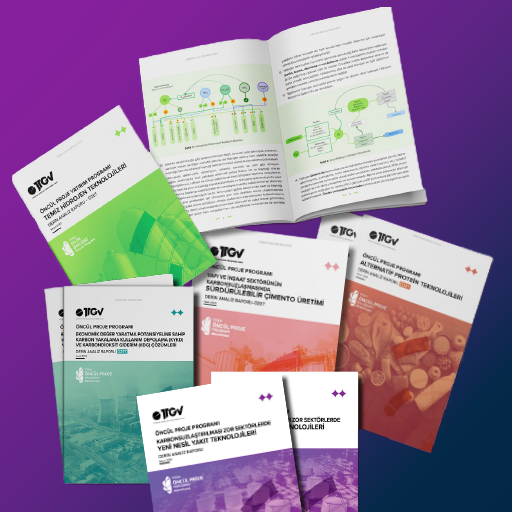
In-Depth Analysis and Pre-Research Topics
- Grid-scale, long-duration electrochemical energy storage technologies to increase the share of renewable energy within our national energy mix,
- Clean hydrogen technologies,
- Sustainable cement production for the decarbonization of the building and construction sector,
- Alternative protein technologies,
- Carbon capture, utilization, and storage (CCUS) and carbon dioxide removal (CDR) solutions with the potential to generate economic value,
- Next-generation fuel technologies for hard-to-abate sectors,
- Non-electrochemical energy storage technologies,
- Battery recycling / second-life battery technologies.